
⬇️ Report available for download
Discovery Bank has topped the 10th edition of DataEQ’s South African Banking Sentiment Index, which analysed 4.8 million online consumer mentions from 1 September 2024 to 31 August 2025. The industry recorded its strongest overall performance in ten years, achieving an overall Net Sentiment of 27%
“This year’s Index reflects an impressive sentiment performance across the sector, with all banks benefiting from stronger engagement and strategic campaigns. However, the findings also show that sentiment is not uniform across experience areas. Reliability, fairness and service remain significant challenges for customers. The industry has made clear progress, but there is still important work to be done to build better, more consistent customer experience,” said Aimee Malan, Managing Director of DataEQ Consulting.
Industry leaders: Discovery, FNB and Absa lead the way
Discovery maintained its position as South Africa’s most positively spoken-about bank, achieving an industry-leading 61% Net Sentiment. This was driven by praise for its rewards programmes, personalised benefits, and overall banking experience, along with campaign-linked advocacy through hashtags such as #DiscoveryBestBank and #TreatMeTuesday.
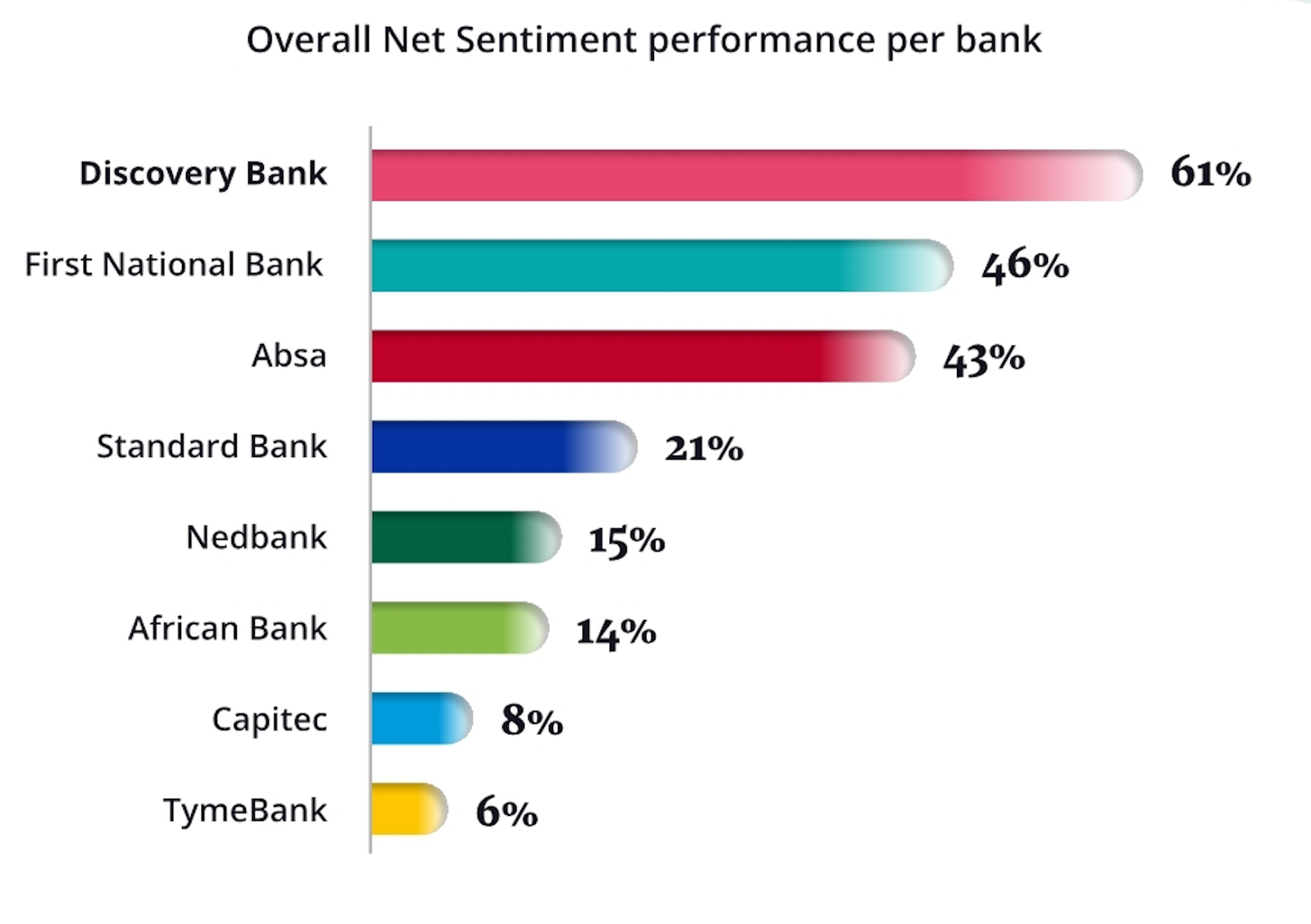 FNB followed with 46% Net Sentiment, supported by positive conversation around eWallet, FNB Connect, and praise towards branch service. The #LoveFNB campaign added further improved sentiment, with customers highlighting app usability, payment convenience, and eBucks rewards. Absa placed third with 43% Net Sentiment, with customers responding favourably to rewards, cashback offers, and its app experience, alongside brand initiatives such as the She’s Next Programme.
Campaigns played a key role in boosting industry sentiment
Campaign-driven engagement had a substantial impact on overall positivity. With campaign conversation included, industry Net Sentiment reached 27%, but dropped to 5% when excluded. The effect was especially pronounced in Operational Net Sentiment, which fell from 29% to -15% without campaigns. Reputational sentiment also shifted meaningfully, declining from 28% with campaigns to 15% without. These shifts highlight how campaigns helped shape the sector’s sentiment profile and amplified positive customer interaction.
Trust pillars reveal pressure points in customer experience
Trust emerged as a central theme, shaped by customer interactions across Security, Access, Fairness & Transparency, Service & Customer Care, and Reliability. The report shows trust was most affected when expectations around reliability or fairness and transparency were not met, reflected in Net Sentiment scores of -86% and -88%. Contributors to negative sentiment included perceived downtime, billing and payment issues, turnaround time concerns, and staff conduct or competency challenges, which appeared across multiple trust pillars. Additional scores included -85% for Security, -78% for Access, and -36% for Service & Customer Care.
Vulnerable customers a growing risk area for the banking sector
With vulnerability becoming increasingly recognised across the global financial services sector as a crucial lens into customers at risk, this year’s Index analysed these experiences for the first time and found that they featured in customer conversation particularly where personal circumstances and banking processes intersected. Net Sentiment across key vulnerability dimensions was notably low, with economic vulnerability at -79%, life-circumstances vulnerability at -69%, and social-demographic vulnerability at -52%. Customers facing debt pressure, income shocks, bereavement, illness, emergencies, mobility challenges, or digital access barriers often found banking processes difficult to navigate during these periods, highlighting how moments of strain can intensify frustration when processes are not able to adapt.
“Online consumer feedback continues to reflect the real, often complex experiences customers face when dealing with their banks. Because this feedback is unstructured, it can be challenging to interpret, but it also provides valuable insight into where customers feel supported and where they struggle. Understanding these signals more clearly will be important as the sector adapts to evolving expectations around service, customer experience, trust and vulnerability,” said Edzani Phiri, Lead Banking Analyst at DataEQ.