Outcome-driven,regulator-aligned structuring of market conduct evidence
The Conduct label structures unstructured customer feedback into clear, outcome-focused signals indicating whether firms are delivering fair and appropriate outcomes in the eyes of consumers.
Aligned to global frameworks like Treating Customers Fairly (TCF) and Consumer Duty, it detects conduct-relevant behaviours and outcomes in consumer interactions, adds root-cause context, and converts external feedback into regulatory-grade evidence to identify risk, pinpoint drivers, and track change over time.
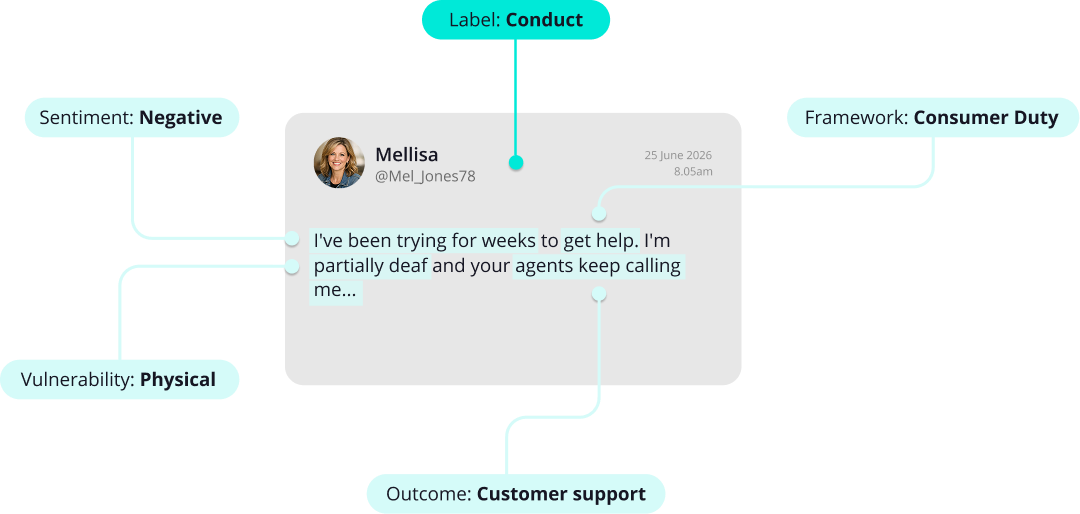
Anatomy of Conduct labelling
Transform anecdotal feedback into structured evidence of a poor consumer outcome, suitable for aggregation, trend analysis, and escalation.
Why conduct evidence is difficult to rely on
Internal conduct data (complaints, cases, call records) is typically structured and governed. The challenge is making sense of external, unfiltered feedback from social media, review platforms, and digital channels.
While increasingly relevant to outcome-based supervision, this data is high-volume, context-dependent, and often ambiguous — and where it is used to evidence consumer outcomes, accuracy is non-negotiable. Automated NLP, keyword rules, and LLM-only data approaches can process feedback at scale, but they typically struggle with the nuance of consumer conversation.
In an outcome-based regulatory environment, this introduces unacceptable risk.
How the Conduct label structures outcome evidence
The Conduct label uses supervised, multi-label classification built for regulatory interpretation:
Outcome-aligned classification
Map feedback to conduct-relevant outcome signals aligned to recognised frameworks
Topic attribution
Identify what is driving poor outcomes to enable targeted remediation
Multi-label logic
Capture multiple drivers in a single interaction
Temporal consistency
Support trend analysis and month-on-month comparability
This keeps conduct outputs interpretable, consistent, and comparable over time.
The DataEQ difference: Governed interpretation at scale
The Conduct label is produced through DataEQ’s EQ Engine a governed structuring pipeline combining machine learning with an additional human labelling layer for quality and interpretation control.
This is not consultancy or advisory judgement, it is scalable, governed human enhanced data labelling layer embedded to ensure decision-grade outputs.
Conduct and vulnerability: Surfacing differential outcomes
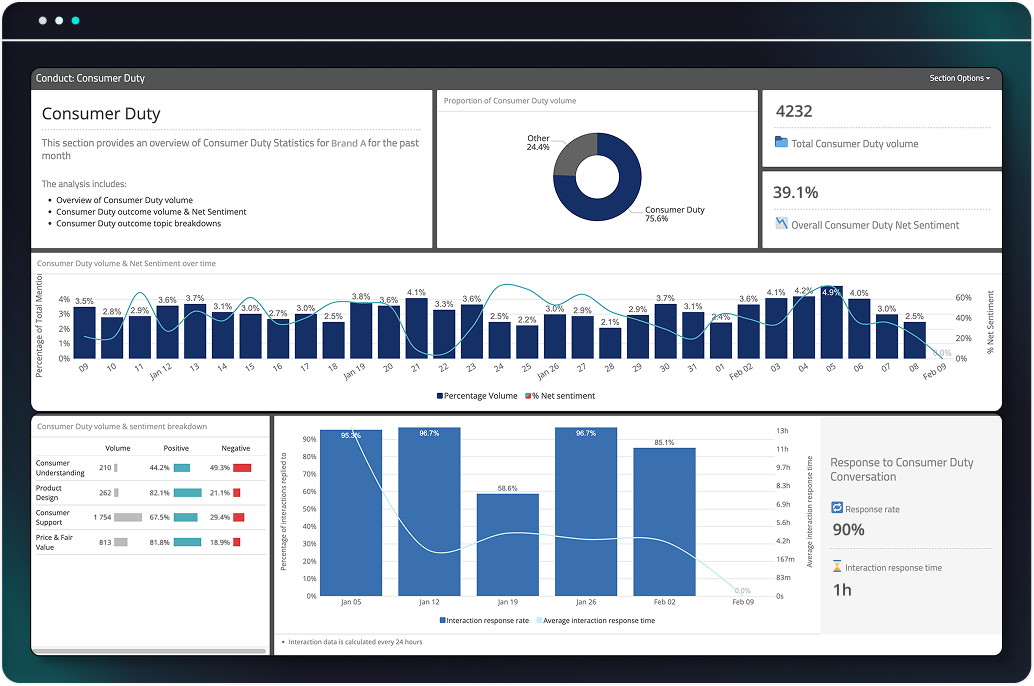
Trend analysis demonstrating outcome improvement following management action
Structured reporting suitable for internal governance and regulatory engagement
Stop tracking noise. Start verifying outcomes with Conduct labelling.
When conduct outcomes matter, insight isn’t enough, you need evidence you can defend. The Conduct label delivers regulator-aligned outcome data for escalation, root-cause action, and measurable improvement.