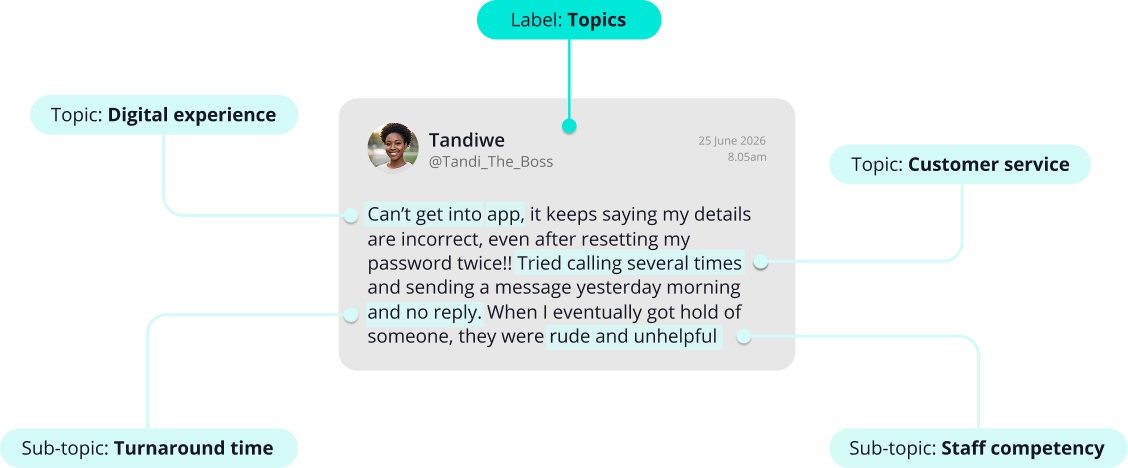
DataEQ’s Topics label enables granular root-cause detection, mapping unstructured feedback to structured, multi-level taxonomies with unmatched precision. Discover exactly what’s driving friction and where to act.
Anatomy of Topics labelling
Each mention is processed by several layers of deep technical knowledge and the application of high-powered, intelligent AI and Human filters, ensuring structured, high quality data outputs.
Unstructured customer feedback contains critical indicators of friction, breakdown, and brand health. But standard NLP techniques often collapse complexity into flat themes, losing the nuance needed for operational action. DataEQ’s Topics label applies multi-label supervised classification against a hierarchical, industry-specific taxonomy, enabling teams to build workflow-ready features from raw data.
Structured design: Custom taxonomies for industry relevance
DataEQ builds sector-specific taxonomies in partnership with CX, risk, and service teams across telecoms, banking, insurance, and retail. Each taxonomy is optimised for:
Domain fidelity
billing ≠ pricing ≠ fraud
Attribution mapping
theme → team → workflow
Hierarchical structure
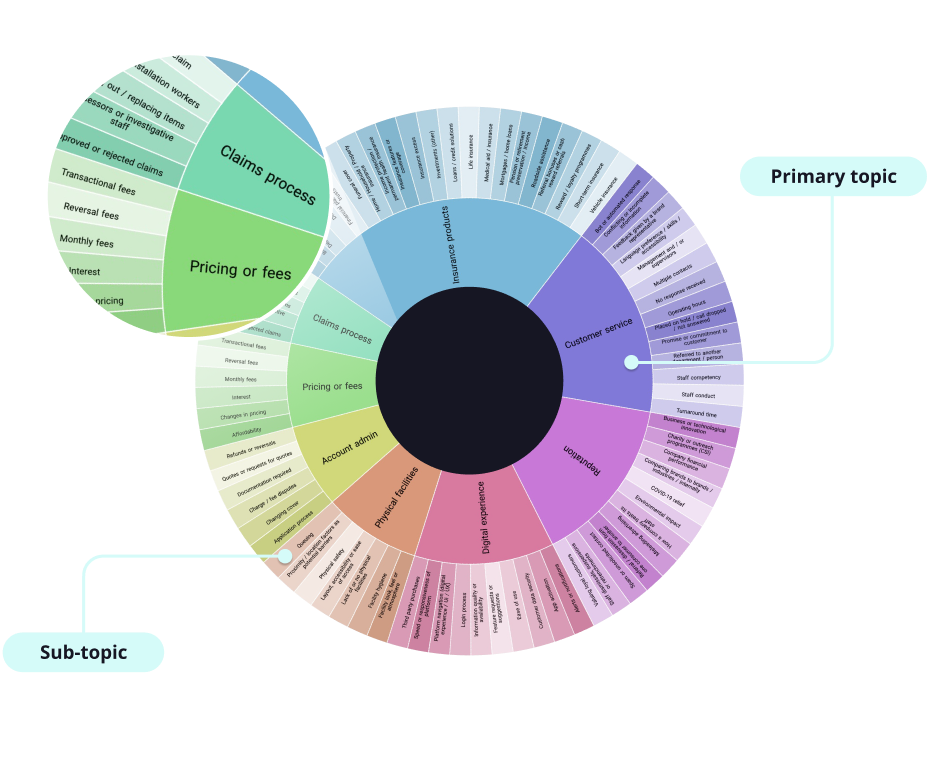
category → topic → sub-topic
Benchmarking consistency
Comparable across time, brands, and regions
Topic structure for insurance feedback. Each segment reflects a quantifiable, benchmark-able issue.
Detect what's interconnected: Topic co-occurrence
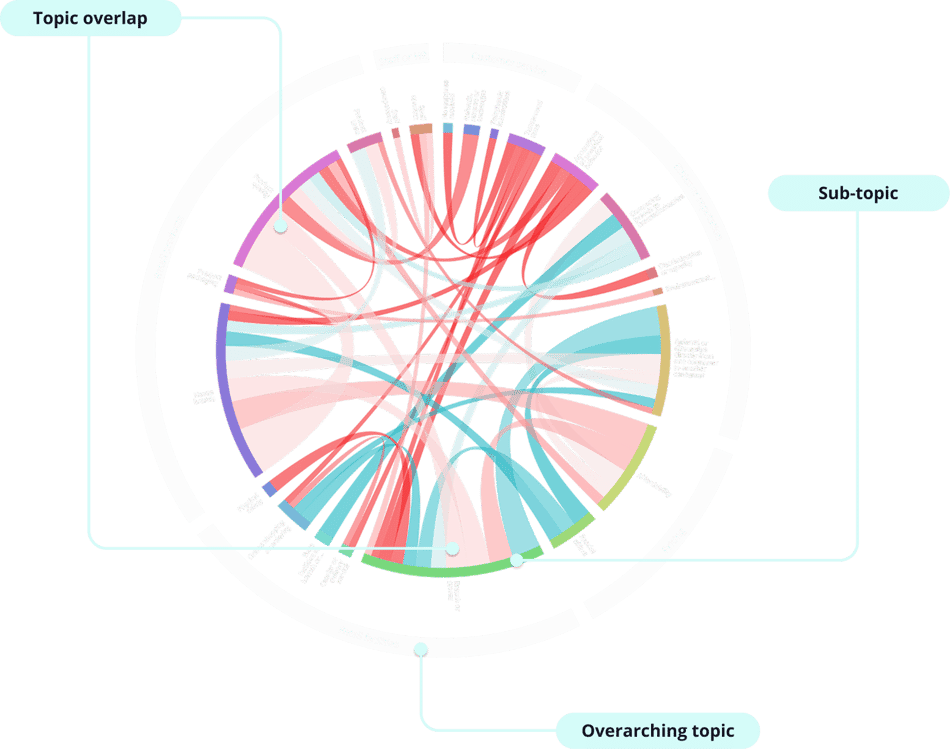
Real-world feedback is rarely about one thing. DataEQ’s EQ Engine uses multi-label topic classification to detect when issues overlap, revealing compound complaints and operational entanglement.
Captures compound root causes hidden in flat models
Enables multi-team attribution and cross-functional escalation
Trains models with richer, real-world signals
Avoids loss of insight from generic, single-label topic models
Issues are clustered together across topic categories For example, turnaround time complaints often co-occur with refund delays, agent tone, and digital support issues.
Why most topic models fail
Generic NLP systems often rely on unsupervised topic modelling (e.g. LDA), keyword rules, or sentence embeddings. These approaches tend to:
Produce ambiguous or overlapping clusters
Fail to apply domain-specific nuance
Ignore co-occurrence and hierarchy
Result in vague outputs like “General complaint” or “Other”
The DataEQ difference
Our Topics label is built for real-world application at enterprise scale. The EQ Engine combines:
Built for data teams
DataEQ’s Topics label isn’t just a reporting layer, it’s a structured, contextual input for deeper data operations.
Train churn, escalation, and sentiment models using validated thematic features
Segment performance by theme for accurate NPS/CES contextualisation
Feed into triage, routing, and alerting systems via labelled pipelines
Support operational benchmarking using shared taxonomies across brands
Labels without structure create noise.
Topics with structure create clarity.
DataEQ’s Topics label lets you analyse, automate, and act with confidence. A key system powered by data that reflects real-world nuance, not generic tags.