Lifecycle-aware classificationfor intent, context and CX decision-making
The Customer Journey label classifies customer interactions by lifecycle state and inferred intent, using signals expressed in natural language.
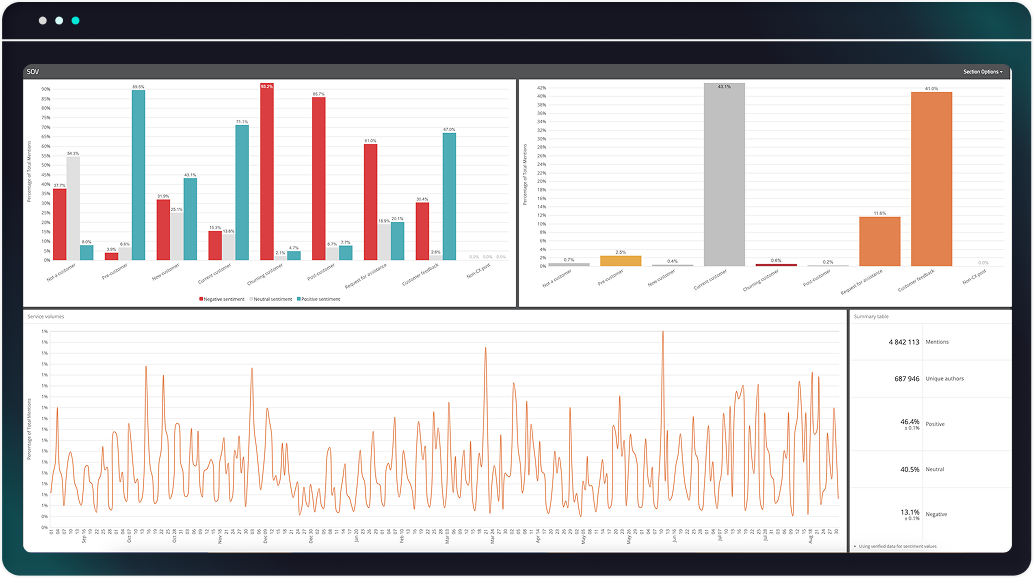
This label assigns each interaction to an intent-driven stage, from pre-customer evaluation through to churn risk and post-customer feedback, so teams can interpret it operationally for routing, prioritisation, modelling, and analysis.
Journey stages: Lifecycle-based classification
Each interaction is assigned a primary journey stage, representing the customer’s current position in their relationship with the organisation.
Journey stages form a standardised lifecycle taxonomy, designed to distinguish materially different customer states (e.g. pre-customer, current customer, churning) without conflation.
Applying a single lifecycle classification per interaction enables consistent segmentation, stable aggregation, and reliable use as a feature in downstream analytics, BI, and machine learning workflows.
Service interactions: Interaction-level intent
Alongside Journey, CX labelling captures interaction intent, what the customer is doing within a given lifecycle stage.
Common interaction types include:
Request for assistance
Explicit requests for help, resolution, or escalation
Customer feedback
experience-based commentary without an active service request
Journey stage and interaction type are applied together as part of CX labelling, enabling multi-dimensional interpretation of customer intent.
CX labelling in context: An integrated signal set
When data is processed for CX use cases, the Journey label operates as part of a composable labelling framework, alongside:
Journey
Lifecycle state
Interaction type
Behavioural intent
Channel
Point of service delivery
Priority
Operational urgency
Together, these labels produce a structured, decision-ready representation of customer interactions, allowing teams to distinguish between exploratory enquiries, routine service interactions, and high-risk churn or escalation scenarios.
Journey acts as the lifecycle anchor, ensuring sentiment, topics, and priority signals are interpreted in the correct customer context.
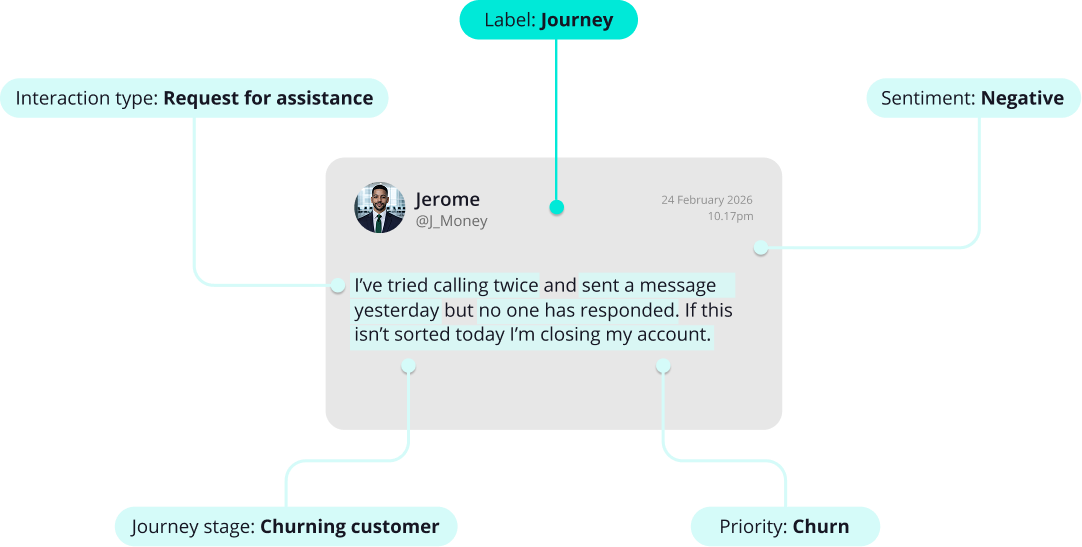
Anatomy of Journey labelling
This structure enables real-time identification of churn risk, correct operational routing, and separation of churn drivers from general CX noise in analysis.
Why conventional CX approaches break down
Most CX systems infer journey context indirectly, relying on:
CRM state as a proxy for intent (often stale or incomplete)
Keyword rules without semantic or lifecycle context
Flat sentiment scores that collapse distinct customer states
These approaches fail because intent is frequently implicit, language varies by channel and region, and the same utterance can carry different meaning at different lifecycle stages.
The result is label leakage, noisy aggregates, and unreliable CX signals for analytics and modelling.
The DataEQ difference
The Customer Journey label is produced by the EQ Engine, DataEQ’s hybrid intelligence pipeline combining:
This approach produces Journey labels that are auditable, explainable, and operationally aligned, rather than heuristically inferred.
Built for data teams and production workflows
The Customer Journey label is designed for direct use across data and ML pipelines:
CX analytics
Segment sentiment, topics, and volume by lifecycle stage
Routing & prioritisation
Combine Journey with Channel, Priority, and Topics for automated triage
Churn modelling
Use lifecycle-aware features instead of raw sentiment signals
BI & reporting
Export structured journey fields into Power BI, Looker, or data warehouses
LLM & evaluation
Assess response appropriateness relative to lifecycle state
Why it matters
Without lifecycle context, customer data collapses into noise. With Journey labelling, interactions become interpretable signals that support action, automation, and modelling.
The EQ Engine produces lifecycle-focussed customer intelligence