Decision-grade identification of customer vulnerability
in unstructured data
Regulators increasingly require firms to demonstrate that customer vulnerability is consistently addressed. Inaccurate classification can lead to customer harm and misconduct risk. DataEQ’s Vulnerability label converts unstructured customer interactions into operationally defined categories, enabling your team to provide accurate routing and support while providing traceable evidence for regulatory review.
Key benefits of Vulnerability labelling
DataEQ builds sector-specific taxonomies in partnership with CX, risk, and service teams across telecoms, banking, insurance, and retail. Each taxonomy is optimised for:
Early risk detection
Surface implicit and emerging vulnerability signals before unintentional customer harm escalates, including non-disclosed and indirect indicators that may be missed by keyword rules or disclosure-based approaches
Regulatory-grade evidence
Generate auditable, explainable customer vulnerability flags suitable for supervisory review, internal governance, and conduct risk oversight - not just internal reporting.
Model-ready features
Provide structured, multi-label vulnerability signals that integrate directly into prioritisation, escalation, and outcome-tracking models
Actionable segmentation
Understand why a customer may be vulnerable so that brand responses, tone, and handling are appropriate and aligned.
Anatomy of Vulnerability labelling
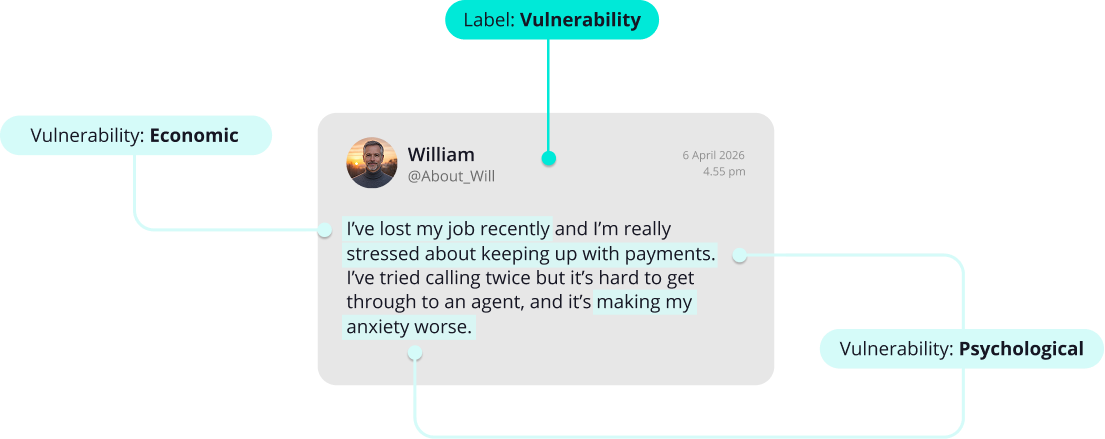
Each mention is processed by several layers of deep technical knowledge and the application of high-powered, intelligent AI and Human filters, ensuring structured, high quality data outputs.
This interaction contains multiple vulnerability drivers, including financial strain and psychological distress, which are represented as standalone signals rather than collapsed into a single tag. This ensures downstream systems can apply the correct response and not just acknowledge the existence of vulnerability.
Core vulnerability dimensions
The Vulnerability label uses a taxonomy-driven, multi-label classification framework, allowing multiple vulnerability dimensions to be applied to a single customer interaction where appropriate.
Economic
Indicators of financial hardship or instability (e.g. job loss, debt pressure, inability to meet essential costs).
Physical
References to physical disability, illness, mobility constraints, or accessibility needs affecting service access or decision-making.
Psychological
Signals related to mental health, emotional distress, trauma, neurodivergence, or cognitive overload.
Social
Indicators of exclusion, isolation, discrimination, or reduced agency linked to identity, age, language, or social circumstances
Situational
Temporary but acute life events (e.g. bereavement, emergencies, loss of utilities, sudden disruption) that elevate short-term risk.
Each dimension is governed by clear inclusion and exclusion criteria, supported by contextual rules and human-validated oversight within the EQ Engine to ensure consistency and audit-ability.
Why conventional approaches fail
Most vulnerability detection approaches break down in real-world data environments:
Keyword lists miss implicit signals and trigger on benign mentions
Binary flags collapse materially different vulnerability drivers into a single, unusable signal
Sentiment models conflate emotional distress with dissatisfaction
LLM-only approaches lack calibration, explainability, and stability under regulatory scrutiny
No human quality control leads to drift, bias, and inconsistent treatment over time
The result is either under-identification, where vulnerable customers are missed, or over-identification, where teams lose trust in the signal and outcomes deteriorate.
The DataEQ difference
Designed to function as a real-world regulatory application at enterprise scale, the Vulnerability label is produced by the EQ Engine, DataEQ’s hybrid intelligence system.
Accuracy is actively governed through inter-annotator agreement monitoring, targeted human review, and drift detection as language, products, and regulatory expectations evolve.
Built fordata teams: Vulnerability monitoring and reporting
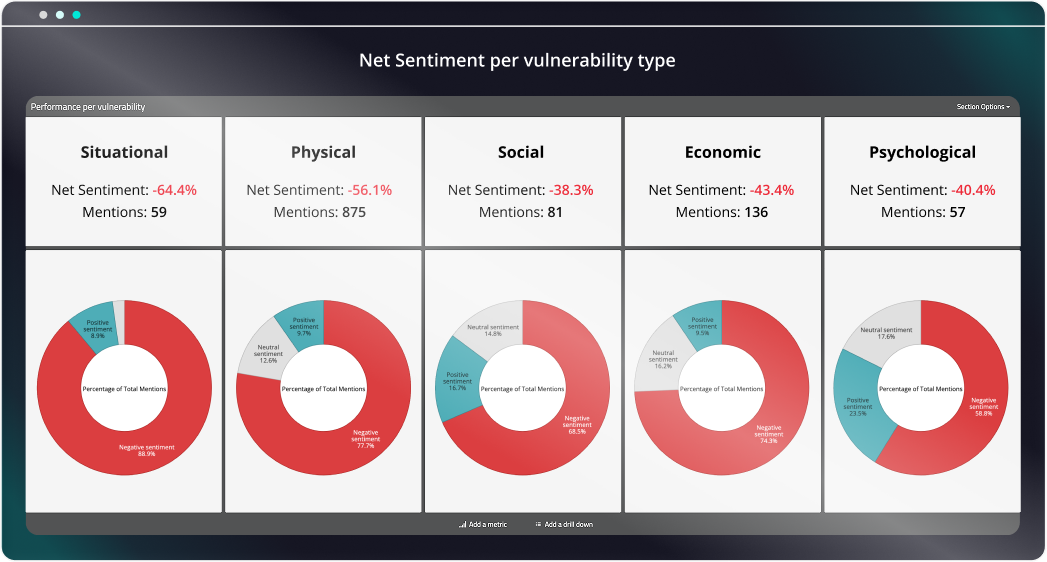
Monitor vulnerability prevalence and distribution across situational, physical, social, economic, and psychological dimensions
Track trends over time, identifying emerging or escalating vulnerability patterns
Compare experience and outcome proxies (e.g. sentiment) for vulnerable versus non-vulnerable interactions
Segment vulnerability by business unit, product, or channel to support targeted operational review
Provide auditable evidence of ongoing vulnerability monitoring to support governance and supervisory engagement
By aggregating human-validated vulnerability labels at scale, these views move organisations beyond case-level review to system-level oversight. Teams can demonstrate not only that vulnerability is identified, but that it is consistently monitored, reviewed, and acted on over time, enabling appropriate responses, continued governance, and defensible supervisory assurance.
Structure large volumes of unstructured customer data at scale and in near real time
Enable vulnerability signals to be prioritised within workflows and routed appropriately
Enrich customer profiles in CRM and case-management systems
Segment outcomes by vulnerability type to monitor differential treatment and evidence improvement over time
Enable evaluation and red-teaming of LLM or agent responses in sensitive scenarios
Vulnerability is rarely explicit, often multi-faceted, and always outcome-critical.
DataEQ delivers decision-grade vulnerability labels to support governance and informed action.