Create structured, actionable urgency signals from unstructured customer feedback
Customer interactions often carry multiple signals simultaneously — intent, risk, emotion, and friction. The challenge is clarifying this complexity for teams can act on.
The Priority label classifies unstructured mentions by business-critical intent, answering the question: Does this interaction require action, if so, what specific action is required?
Applied by the EQ Engine across Analyse and Engage, Priority labelling ensures that alerts, routing, and responses are driven by a shared, decision-grade logic.
Key benefits
Cut through the noise
Isolate genuinely high-impact interactions without overwhelming teams with false urgency.
Drive faster, more consistent responses
Ensure critical conversations are surfaced first across dashboards, alerts, and service queues.
Align insight with execution
Use the same Priority logic to power reporting, routing, escalation, and SLAs, eliminating disconnects between analysis and action.
Improve retention, acquisition & risk control
Distinguish churn intent from routine service friction, purchase signals from general interest, and reputational risk from operational complaints.
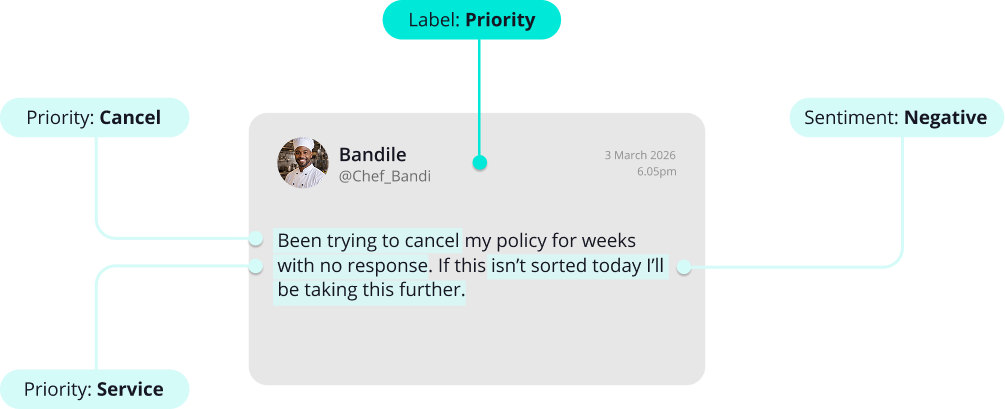
Anatomy of Priority labelling
This structure makes the decision explicit: This is not generic dissatisfaction, it is an active churn signal with escalation risk, requiring immediate intervention.
How Priority labelling is structured
Priority is applied using a business-aligned intent framework known as RPCS:
Mentions indicating potential reputational, regulatory, legal, or operational risk, including threats of escalation, allegations of unethical behaviour, safety concerns, fraud signals, or high-impact incidents.
Signals of acquisition or conversion intent, whether explicit (“looking to switch”) or implicit (“is this covered if I upgrade?”).
Indicators of churn intent, including cancellation requests, exit signals, or sustained dissatisfaction linked to leaving.
Requests for help, support, resolution, or follow-up related to existing products, services, or journeys.
Why conventional approaches fail
Most prioritisation systems rely on brittle proxies:
Keyword rules generate false positives and miss contextual urgency
Sentiment-only escalation conflates emotion with intent
Generic LLM confidence scores lack consistency, accountability, and audit-ability
No human validation leads to alert fatigue and degraded trust
The result is queues full of noise, inconsistent responses, and critical issues surfaced too late.
The DataEQ difference
Priority labelling is produced by the EQ Engine, DataEQ’s hybrid intelligence system, combining:
This ensures Priority remains decision-grade, trusted by data teams and actionable by agents in Engage.
Crucially, Priority is not treated as a one-off classification step. It is maintained as a living signal, continuously monitored and refined based on steps taken in the customer interaction.
Built for data teams and operations
The Priority label is designed to plug into enterprise workflows
Monitor high-impact conversation volumes and trends
Trigger alerts for emerging risk, churn spikes, or acquisition opportunities
Segment sentiment, topics, and performance by Priority intent
Engage
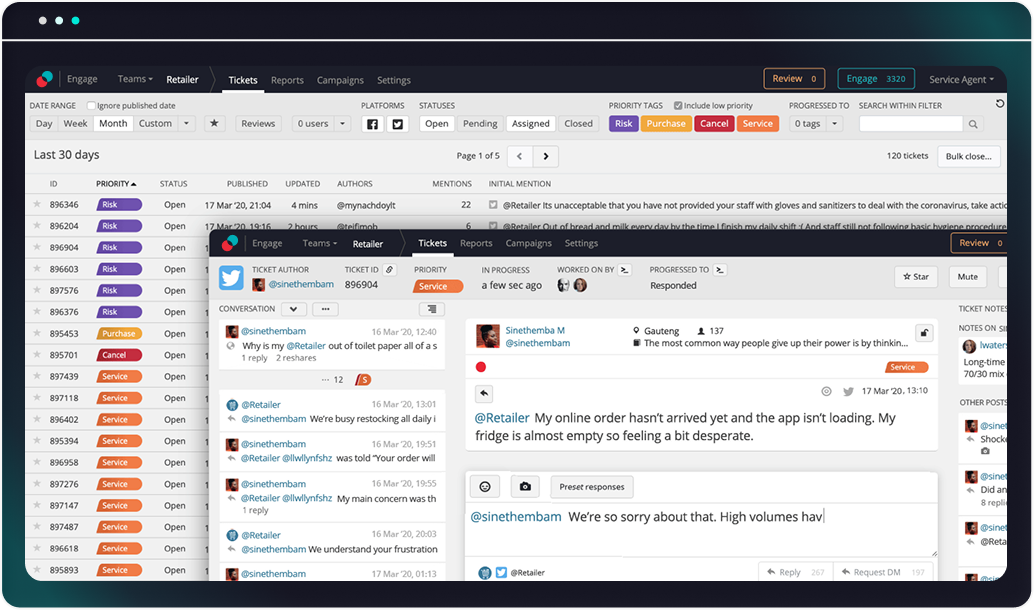
Drive intelligent queue ordering and agent assignment
Power escalation logic and SLA measurement
Ensure consistency between what analysts flag and what agents act on
Data & AI
Train and evaluate routing, churn, and escalation models
Feed BI tools and CRMs with structured urgency signals
Support auditable decision-making in regulated environments
When urgency is grounded in reliable signals, teams can can act with confidence and efficiency
While generic systems surface more data, DataEQ’s Priority label surfaces the right data, structured around what teams actually need.