
SA Telecoms Indices available for download:
South Africa's telecoms industry is failing to close the loop on customer complaints across every sub-sector, according to DataEQ's 2026 SA Telecoms Customer Experience Index, a four-part study covering Internet Service Providers (ISPs), Mobile Virtual Network Operators (MVNOs), Network Providers, and Fibre Network Operators (FNOs). The research, based on more than 811,000 social media mentions collected between 1 October 2025 and 31 March 2026, found that turnaround time was the leading driver of cancellation intent in all four sub-sectors. The share of conversation that could be resolved by AI ranged from just 29% among ISPs to 78% among network providers.
Key Findings at a Glance
- Turnaround time was the number one driver of cancellation intent in all four sub-sectors, and one of the top two drivers of negative customer service conversation in three of the four.
- AI-addressable conversation ranged from 29% (ISPs) to 45% (FNOs), 74% (MVNOs) and 78% (Network Providers).
- Response gaps were severe. Half of high-priority ISP interactions went unanswered, rising to six in ten among network providers, 66% among fibre operators, and 78% among MVNOs.
- Call centres carried the highest volume of channel-specific complaints in every single report, though email, where present, was typically rated even more negatively.
- No FNO and no ISP recorded a positive Operational Net Sentiment score.
Best and Worst Performers by Sector
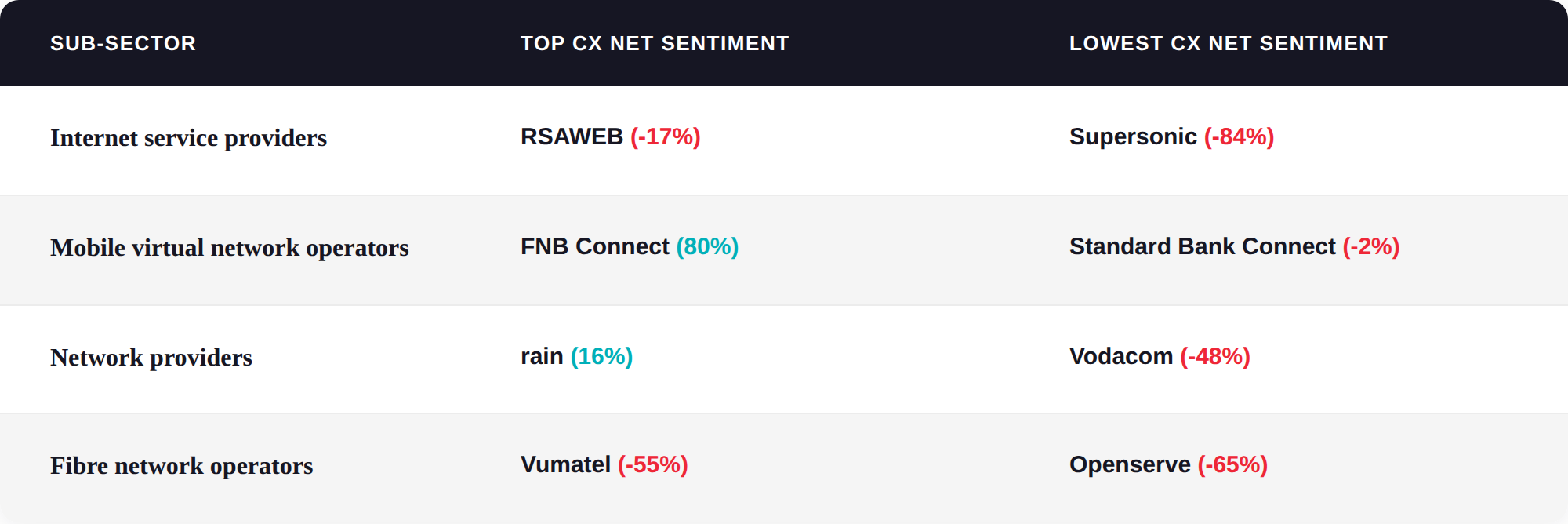
FNB Connect posted the most positive Operational Net Sentiment score across all four reports, driven by branch staff proactively introducing customers to its Connect product during in-person banking interactions. Positivity wasn't confined to MVNOs, though: two network providers, rain (16%) and Cell C (11%), also recorded positive scores, making Network Providers the only other sub-sector to produce a positive performer. ISPs and FNOs, by contrast, saw no brand escape negative territory during the reporting period.
Turnaround Time: The Common Thread in Cancellations
Turnaround time was the top cancellation driver industry-wide in every one of the four reports, featuring in 68% of ISP cancel conversation, 66% for FNOs, 48% for network providers, and 47% for MVNOs. The pattern held even where overall sentiment looked healthier: MVNOs were the only sub-sector where campaign-driven positivity lifted most brands (four of five) into positive overall territory, yet Capitec Connect and Standard Bank Connect recorded turnaround-time Net Sentiment scores of -82% and -96% respectively. A strong headline score, in other words, can still mask a serious follow-through problem underneath.
"Every one of these four reports tells the same underlying story: customers are not generally frustrated because something went wrong, they're frustrated because nothing happened after they reported it," said Sarah Lamb, MD at DataEQ. "Faults get acknowledged, reference numbers get issued, and then the trail goes cold. That gap between logging a problem and resolving it is now the biggest lever the industry has to pull, and it's one that AI can help close for a meaningful share of the simpler queries, freeing human agents for the disputes that actually need judgement."
The AI Opportunity, and Its Limits
AI-addressable conversation varied sharply by sub-sector, and the theme-level data shows why a blanket approach would be a mistake. In every report, the mentions AI could safely handle clustered around enquiries, compliments and basic troubleshooting, while billing disputes, cancellations and reputational risk consistently required a human agent.
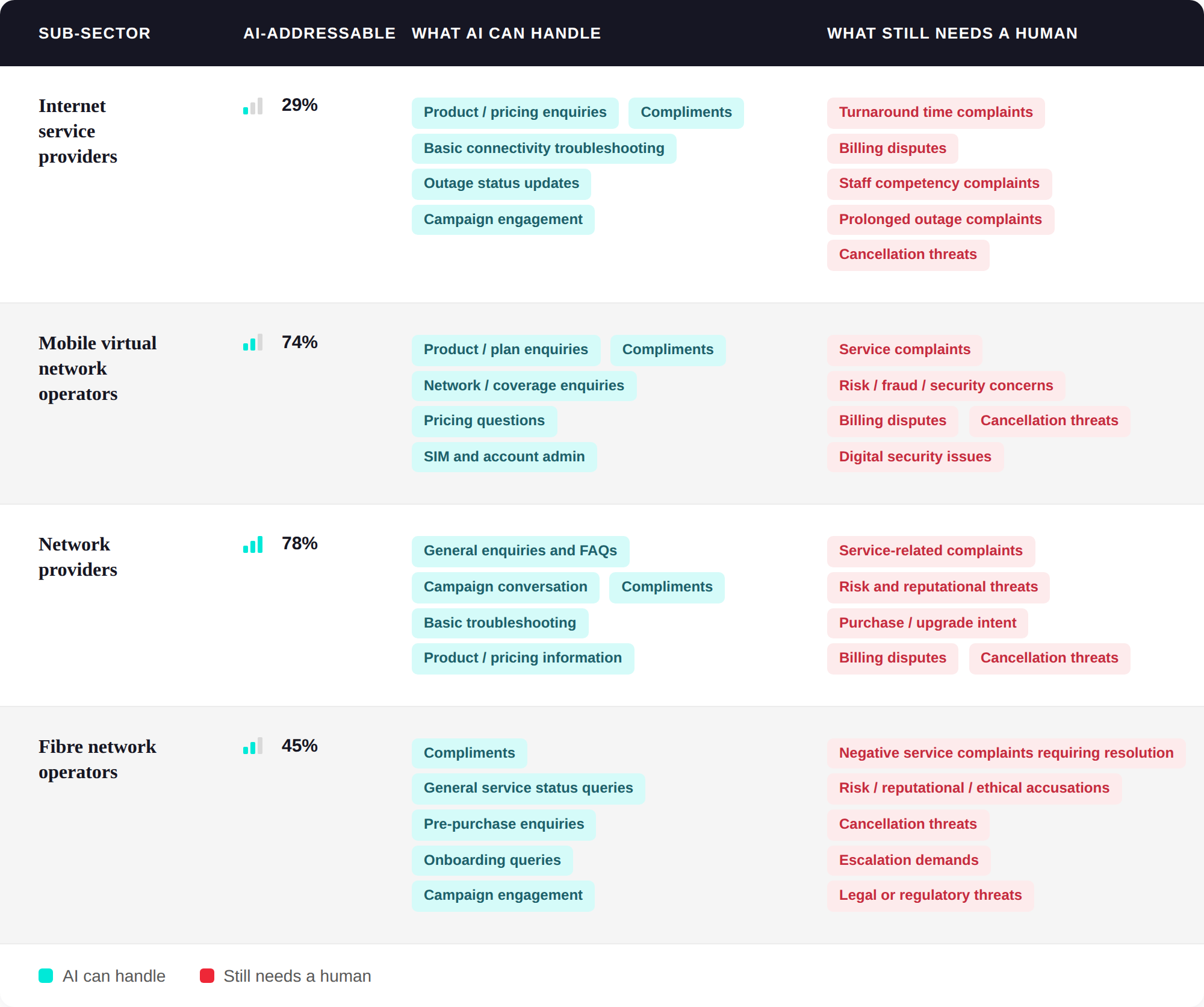 Network providers and MVNOs stand out as the sub-sectors with the most immediate AI opportunity: roughly three-quarters of their conversation (74% and 78% respectively) sits in the low-complexity, high-volume category AI is built for. ISPs and FNOs, by contrast, generate far more of the complex, judgement-heavy conversation, such as active faults, billing disputes, and cancellation threats, that still requires a human to resolve.
"There's a huge opportunity for telco brands where AI could realistically take on a significant share of day-to-day customer service conversation, freeing up agents to focus on the more complex and time-sensitive queries," said Shelley Bredin, Telecoms Lead at DataEQ. "But the data draws a very clear line. Consumers are comfortable with AI handling generic enquiries, FAQs and compliments; they are not comfortable with AI when it comes to more complex, emotive engagements, such as dealing with billing disputes or cancellation threats. A blanket AI rollout that ignores that distinction risks doing real and lasting reputational damage. Humans still have a role to play, especially when it comes to emotionally-charged queries, the operators that get this mix right will be the ones who stand out."
Social Media's Dual Role: First Point of Contact and Last Resort
Call centres generated the highest volume of channel-specific complaints on social media. Call centres weren't always the most negatively rated channel in terms of Net Sentiment: email scored even worse in three of the four reports (ISPs, MVNOs, and network providers), but their sheer volume made them the industry's defining service bottleneck.
Social media plays a dual role in this picture. For some customers, it is the first port of engagement; they go straight to a brand's social channels rather than the call centre. For others, the Network Providers report notes explicitly that customers raising issues on social platforms had typically already attempted to resolve them through traditional channels without success, meaning social media functioned there as a last resort once call centres, email or in-app support had already failed. That escalation pattern held across ISPs, MVNOs, network providers and fibre operators alike, underlining social media's growing role as both a direct engagement channel and a pressure valve for the industry's service failures.
The ISP-FNO Accountability Gap
The ISP and FNO reports also exposed a structural accountability gap between the two sub-sectors. ISP customers were frequently redirected to the underlying fibre network operator when faults occurred, despite holding their contract with the ISP, a pattern consumers described as a failure to take ownership rather than a legitimate technical distinction. The FNO report confirmed the same gap from the other side: fibre operator customers escalated across call centres, email and social channels only to find agents who could log a complaint but not progress it, with responsibility passed back and forth between the FNO and the ISP reseller. At Telkom, 89% of service conversation referenced fibre specifically, with customers caught in an accountability loop between Telkom and Openserve. Customers saw neither party as owning the resolution, and had to manage the escalation chain themselves.
DataEQ Telecoms Index
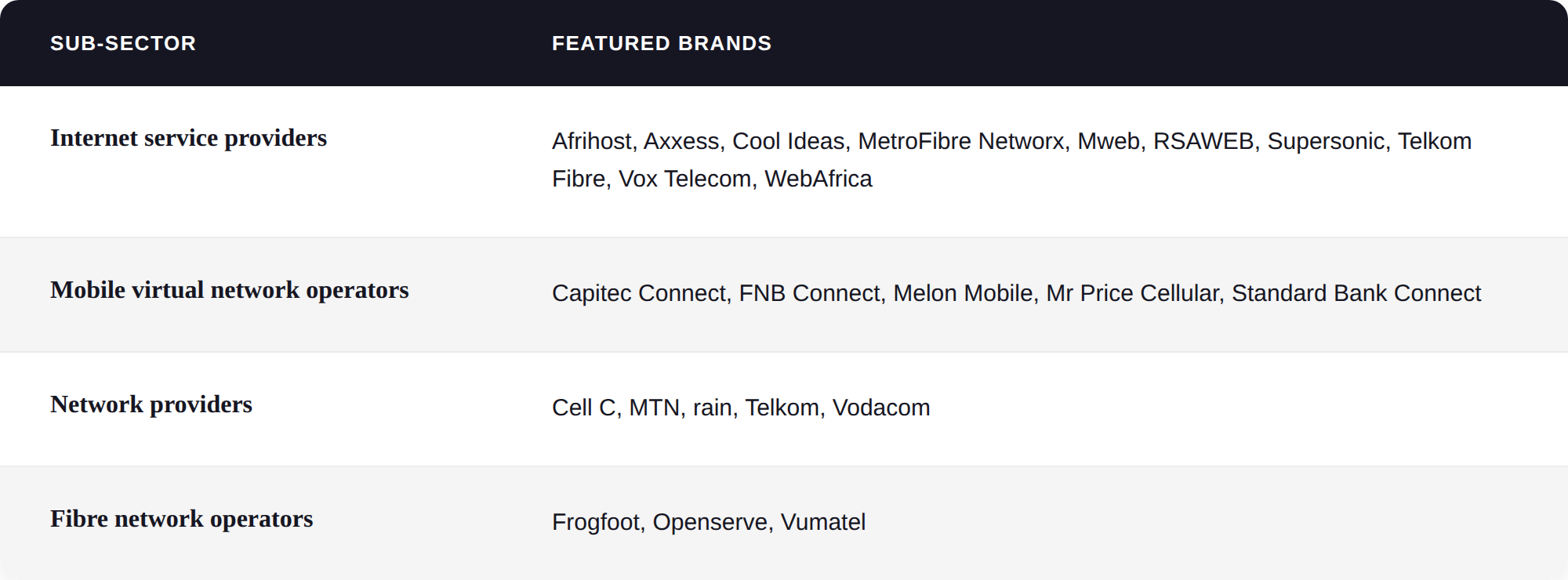
DataEQ's SA Telecoms Customer Experience Index draws on verified sentiment and topic data extracted from X, Facebook, and Hellopeter processed through the DataEQ EQ Engine to anlayse the performance of SA's leading telecoms brands, split according to network providers, ISPs, FNOs and MVNOS
Brands featured:
- ISPs: Afrihost, Axxess, Cool Ideas, MetroFibre Networx, Mweb, RSAWEB, Supersonic, Telkom, Vox Telecom and WebAfrica
- MVNO: Capitec Connect, FNB Connect, Melon Mobile, Mr Price Cellular and Standard Bank Connect
- Network Providers: Cell C, MTN, rain, Telkom and Vodacom
- Fibre Network Operators; and Frogfoot, Openserve and Vumatel.
DataEQ
DataEQ is a consumer intelligence company that measures brand reputation and customer experience through the analysis of public social media conversation. Using its proprietary EQ Engine, DataEQ applies human-verified sentiment and topic classification to consumer conversation at scale, giving brands a direct read of customer opinion. Not a survey, not a panel, but the real-time voice of the customer.